

One hundred years of Don Lorenzo Milani
Pedagogy of the Word
ARTICOLI
Davide Amori
5/27/202310 min read
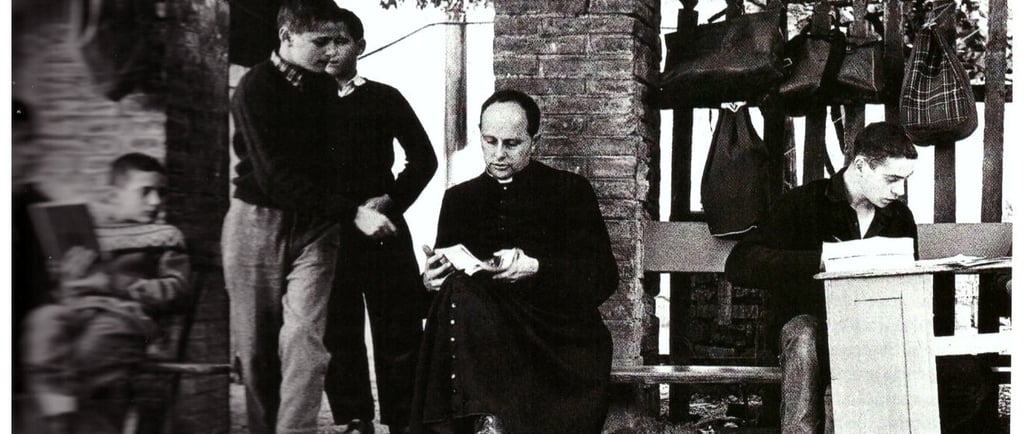
A radical, uncompromising parish priest who openly took sides — always standing with the poor, the marginalized, and a social class condemned to mourn itself because, beyond public statements, good intentions, and respectable thinking, very few had ever truly cared about them. This is, of course, only a partial description of one of the most important educational and ecclesiastical figures of the last century: Don Lorenzo Milani. One hundred years after the birth of this original personality, it is fitting to pause and reflect on the legacy he chose to leave us. Don Lorenzo was born on May 27, 1923, in Florence to Albano Milani and Alice Weiss, the latter of Jewish origin. He was born into an educated bourgeois family. In 1930 the family moved to Milan, where Lorenzo began his classical studies. In 1941 he also devoted himself to painting at the Brera Academy of Fine Arts. The growing social tensions within Italian politics, racial ideology, and the widespread hostility toward Jews had already led the Milani family to convert to Catholicism, rightly believing this might spare them the persecutions spreading in those years. In the autumn of 1942, for war-related reasons, the family returned to Florence. During this period Lorenzo met a figure who would prove decisive for his later life choices: Don Raffaello Bensi. From this encounter — and perhaps also from his growing interest in sacred art — Don Lorenzo developed a deep passion for the study of the Gospel. Under the guidance of Don Bensi, who would remain his spiritual director until his death, he decided to enter the seminary in 1943. Four years later he was ordained a priest. In October 1947 he was appointed curate in San Donato di Calenzano, where he founded an evening school for the humbler members of his parish: workers and farmers. However, following tensions between him and certain diocesan circles, he was ordered to leave San Donato di Calenzano in November 1954 and move to the remote village of Barbiana. This event proved deeply significant for Don Lorenzo. Letters from that period reveal profound melancholy, almost a sense of abandonment, to which he nevertheless responded by constantly proclaiming his complete love for his Church family. A letter sent to Don Raffaele Bensi is emblematic in this regard, in which he makes a heartfelt appeal: “[…] Please no longer speak to me or to others about this parish as if it were a temporary testing ground while waiting for something else […] I embraced obedience once and for all — and that is enough.”1“These are blows one can endure once in a lifetime — and no more. I left San Donato because I had sins to atone for, but here I will try not to commit any, so that no one will take me away again. And if, to my misfortune, I were torn from this parish as well, you may be certain I would accept no other parish, nor any other assignment […] One cannot play with people’s nerves as if they were checkers pieces, nor with a man’s life and his affections as if he were an experimental animal […]” 2. In Barbiana, however, Don Lorenzo showed an extraordinary desire to give himself completely. In May 1956 he founded a vocational school for his first six students. Meanwhile, he had begun writing one of his most controversial works, Pastoral Experiences. The text is marked by Don Lorenzo’s characteristic language: that of someone who does not accept “no” as an answer, who immediately rejects ambiguous or non-committed attitudes toward the marginalized — those very protagonists of the Gospel whom he recognized in the poor, the uneducated, the working class, and above all in the unfortunate mountain villagers of Barbiana, the same poor found throughout the world, the “oppressed,” a term dear to another educator who, in those very years, starting from Recife in Brazil, would build a worldwide pedagogical movement on the relationship between oppressed and oppressors: Paulo Reglus Neves Freire. Class struggle, then, seems to emerge from Don Milani’s educational action, yet it cannot be understood as intrinsically aggressive or inspired by the incendiary revolutionary spirit experienced, for example, in many Soviet countries. Don Lorenzo’s revolution is peaceful; indeed, it strives to build a more just society in order to prevent greater conflicts in the future. As he wrote in a letter: “Dear Madam […] that evening school […] has always been the work in which I placed the greatest hope. More necessary than bread. To educate the ignorant, to remove the rust from so many fine minds degraded by labor and social inferiority. To extend to everyone the most jealously guarded privilege of the children of the rich, because it is the key to every achievement. To try to prevent a bloody revolution through a voluntary and inner revolution. To build the intellectual foundations for a religious rebirth in a world of the poor that no longer lives a Christian life simply because its life is no longer even human […] I trust that today you will, with equal foresight, help the revolution come and ensure that it be Christian […]”3. In this remarkable document we can observe the priest’s emblematic drive, permeated by a spirit of humanization — not always perfectly measured, yet undoubtedly firm and clear in its intentions. What strongly emerges is the essential connection between evangelical commitment and pedagogical commitment. The two dimensions appear increasingly inseparable, almost cathartic. In this regard, it is useful to consider a letter addressed to Giampaolo Meucci, Deputy Public Prosecutor at the Court of Florence, who in 1966 would be appointed President of the Juvenile Court of the same city: “[…] remain within your lofty realm and continue to write fine, intelligent, and good journals, as I consider yours to be. But with your permission I will go on believing that one hour of my school in Barbiana is worth more than twelve in the hands of all the intellectuals of Italy. Not because I am worth more than you, but because the public I have chosen is worth more […]”4. As mentioned, in this case too the priest does not spare harsh words — though delivered with an ironic tone — toward his intellectual friend, guilty in his view of devoting himself first to his peers rather than to the least. Another important letter addressed to Meucci is now available to us, from which the core of this figure’s evangelical and pedagogical mission can be drawn: “[…] In short, you are deserving in the coming of the Kingdom of God, which will certainly arrive through the school, and so I thank you […]”5. At the same time, as mentioned earlier, Don Milani devoted strong commitment to writing his work Pastoral Experiences. The book was intended as a contribution to the dialogue within Pastoral Theology. In it, Don Lorenzo invested significant theological effort, combined with his characteristic narrative style, marked by harsh expressions bordering on provocation. This provoked widespread dissatisfaction among many parish priests and intellectuals, to the point that, although the book received the imprimatur of Cardinal Elia Dalla Costa and was enriched by a highly esteemed preface from the Cardinal of Camerino, Monsignor D’Avack, it was withdrawn from circulation by decree of the Holy Office in 1958 as it was considered inappropriate reading. Don Lorenzo’s attempts to explain that, despite certain provocative passages, the book remained faithful to orthodoxy and aimed only to describe a method suited to a specific place and time — without the presumption of universal validity — proved useless, as he explicitly reiterated in a letter to Monsignor D’Avack summarizing the reactions caused by the work: “[…] In other words, I do not regret having published the book and I hope you do not regret having commented on it. This does not mean that, if I could go back, I would not wish to change certain things. For example, I would clarify even more unequivocally than I already have that I did not intend to write a treatise of pastoral theology with the force of law for all places and circumstances. My attention was focused on a much more limited horizon […]”6.To the pain caused by the censure received for his work was added, in December 1960, physical suffering. In a letter to Gostino, his student, we read for the first time: “In these days we have all been picking olives […] I had to stop because I am ill.”7. Sadly, the events that followed were almost always unfavorable for the prior. In October 1960 he wrote a letter together with Don Bruno Borghi requesting clarification regarding Cardinal Florit’s sudden decision to remove Monsignor Bonanni from his position as rector of the Major Seminary of Florence. The letter, addressed to his fellow priests of the diocese, bore the well-known harsh tone he used whenever he perceived situations as unjust. The protest the two had hoped for, however, did not occur. The clergy of the Diocese of Florence preferred to avoid deepening divisions. The result was that Cardinal Florit adopted an even stricter stance, calling Don Lorenzo and Don Bruno to order according to the principle of obedience and declaring their action inconsistent with the priestly spirit.8.Within the extremely tense climate of that period we must therefore place one of the most important events in Don Lorenzo’s life: the publication of the Letter to the Military Chaplains. On February 11, 1965, several military chaplains in Florence approved a controversial motion declaring conscientious objection “an insult to the Fatherland and to its fallen […] and foreign to the Christian commandment of love […]”.9. Don Lorenzo’s critique was harsh and at times fierce. First, as was his custom, he brought the issue to his students and, after long discussion, began writing together with them the outcome of their reflections. The theses advanced in the letter ranged across several issues: from the ethical question of conscientious objection to legal reflections on the principles of constitutional legitimacy. Particularly emblematic from a pedagogical perspective is a specific passage of the letter: “[…] If you claim the right to divide the world into Italians and foreigners, then I will tell you that, in your sense, I have no homeland and I claim the right to divide the world into the dispossessed and the oppressed on one side, and the privileged and the oppressors on the other. The former are my homeland, the latter my foreigners.”10.This passage is particularly striking when one considers that, several years in advance, it addressed the theme of class struggle from a pedagogical perspective that, in 1971, would be presented to the world by Paulo Reglus Neves Freire with Pedagogy of the Oppressed. Of course, class struggle was not a new topic for pedagogy; nevertheless, it is remarkable that, many years earlier, Don Milani had anticipated the same language and themes of one of the greatest authors of the last century. His Letter to the Military Chaplains, however, did not achieve the hoped-for result of opening a new phase of dialogue; instead, it led to an indictment and a trial for the alleged advocacy of a crime. The increasingly serious health conditions of the priest unfortunately prevented him from appearing at the trial before the court in Rome. Although many offered to cover his legal expenses, he chose to request a court-appointed lawyer, with the sole condition that the attorney present to the judges a written defense prepared by him, without adding anything else. Following this chain of events, Don Lorenzo prepared a letter of enormous pedagogical and ethical significance concerning war and conscientious objection. After a brief introduction explaining the reasons for the defendant’s absence, the letter was divided into two main sections in which Don Lorenzo presented his arguments first from his perspective as a teacher and then as a priest. The most significant lines, however, remain those that probably best represent his pedagogical and pastoral thought: “[…] On a wall of our school, written in large letters, is ‘I care.’ It is the untranslatable motto of the best American youth: ‘I care, it matters to me.’ It is the exact opposite of the fascist motto ‘I don’t care.’”11. AFollowing the trial, Don Lorenzo was acquitted by decision of the judges, although, upon appeal by the prosecutors, the verdict was later changed to a conviction. This news, however, never reached the priest, who had already died due to the worsening of his health on June 26, 1967, at only 44 years of age. Don Lorenzo nevertheless managed to leave the world one final, innovative and vibrant reflection with what is probably his most famous work: Letter to a Teacher. The text was written in 1966 and printed in 1968. Signed “School of Barbiana,” Letter to a Teacher was addressed more to peasant families than to the world of education. From its pages still emerge all the themes central to Don Lorenzo Milani’s pedagogical and pastoral action: class struggle for a Gospel of the poor and a Kingdom that necessarily passes through their liberation; the saving and qualifying power of the word, through which the people take possession of active citizenship, the only one capable of humanizing them; individual responsibility, requiring constant attention to the needs and necessities of the world — especially of the least — without which there can be salvation for anyone. The work of the prior of Barbiana, last among the last, today seems more alive and necessary than ever. His life’s witness reminds us that the world does not need only technique and progress, but also the fundamental contribution that faith, pedagogy, philosophy, and civic commitment can offer in sustaining the human being along the course of history. One century after his birth, Don Lorenzo offers us a hard, direct teaching — a vigorous shake that awakens the conscience; for this reason we cannot fail to remember a personality such as his. If it is true that the genius of great men often lies in the ability to look beyond their own time, seeking solutions to real problems and perceiving beyond the veil of reality and concepts, then we may say he grasped a profound truth: the human being lives through love for the weakest, within a circle of affection and self-giving commitment that asks nothing in return except the joy of giving oneself, according to the teachings of Christ. In this centenary, therefore, we hope for a renewed appreciation and rediscovery of this priest, who gave his short life to the oppressed, so that we might remember that the flower of salvation often does not grow in the garden of splendid villas but sometimes in the rocky soil of remote and difficult places, in cultivated ground like that of beautiful Barbiana.
1This refers to his decision to accept leaving San Donato di Calenzano without opposition, A.N.
2 Letter to Don Raffaele Bensi — Florence, Barbiana, December 29, 1954
3 Letter to Mrs. Carolina — Florence, San Donato a Calenzano, October 12, 1950
4 Letter to Giampaolo Meucci — Florence, Barbiana, March 2, 1955
5 Letter to Giampaolo Meucci — Florence, San Donato a Calenzano, December 19, 1952
6 Letter to Monsignor Giuseppe D’Avack — Camerino, Barbiana, November 9, 1958
7 Letter to Gostino — Milan, Barbiana, December 17, 1960
8 Circular from Cardinal Florit to the Most Reverend Auxiliary Bishop, to the Camerlengos of the Metropolitan Chapter, to the Rectors of the Florentine Seminaries, to the Urban and Rural Vicars, and for the information of all the priests of the Archdiocese — Florence, October 11, 1964
9 Statement of the Tuscan Military Chaplains — February 11, 1965
10 Letter to the Military Chaplains — Barbiana, February 22, 1965
11 Letter to the Judges — Barbiana, October 18, 1965
Contact
Write to me for questions or clarification
Phone
© 2025. All rights reserved.